If your app sends prompts through an AI router or a cheap hosted inference provider, assume a stranger may have read some of them. That’s the blunt takeaway from new research by HD Moore, chief research officer at the security firm Dragos. His team sent nearly two million AI prompts laced with unique, trackable secrets to AI services and watched where those secrets turned up. They turned up in a lot of places they shouldn’t have.
Within days of the report, OpenRouter cut three providers from its platform and Together AI disclosed its own prompt leak. Here’s what happened and what to check on your side.
What Dragos actually did
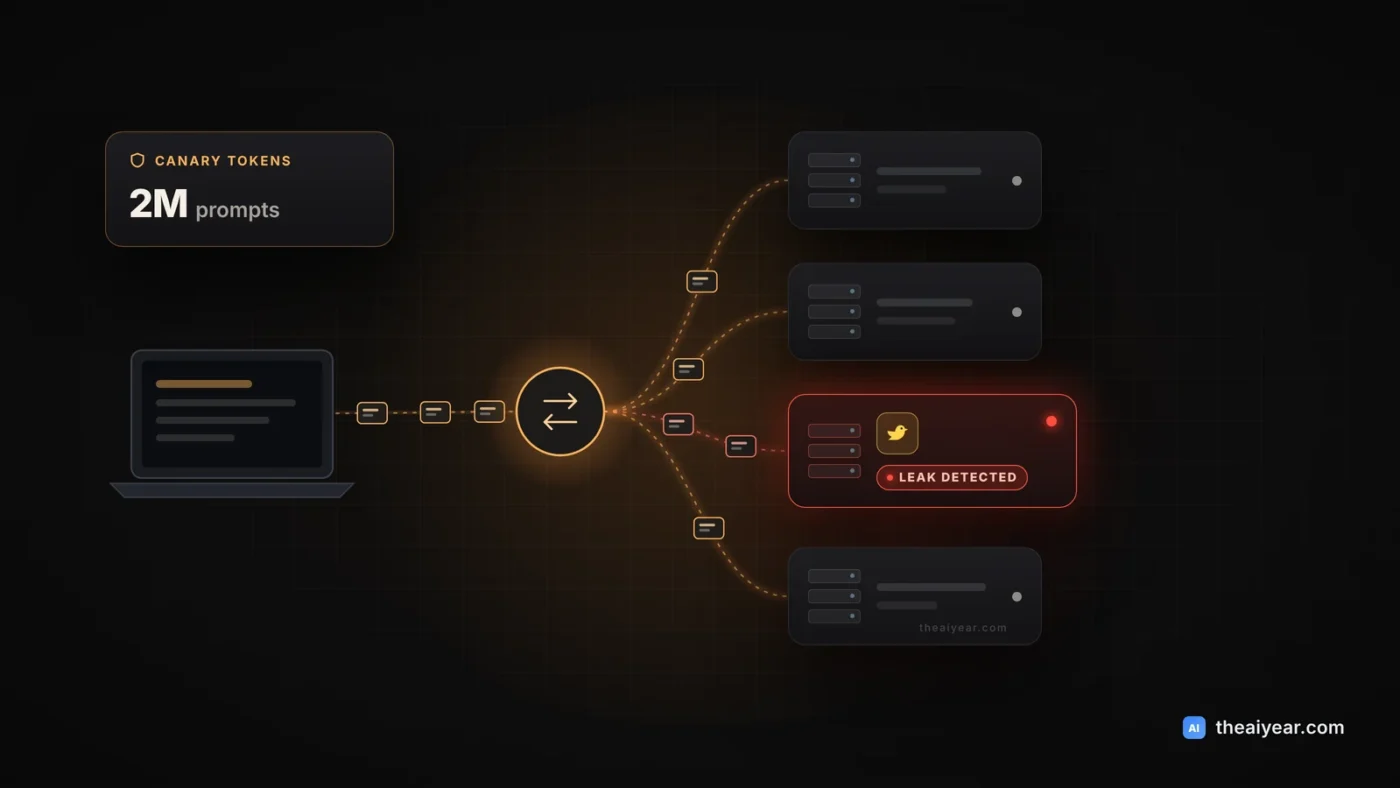
From July through November 2026, Moore’s team seeded prompts with “canaries”: AWS keys tied to empty, fully logged accounts, passwords, DNS names, unique URLs and private git repository references that existed nowhere else. Each secret went into exactly one prompt sent to one provider. If anyone ever used one, the team knew which prompt, model, router and privacy setting had carried it. Dragos says it started with free Thinkst Canarytokens and later built a dedicated service for seeding prompts.
As Ars Technica explains, prompts are encrypted in transit but decrypted at each hop. A router reads your prompt, passes it to a provider, and that provider may be another router. Every hop can see the full request and response.
Three findings that should worry any AI team
Dragos grouped its results into three buckets.
- Compromised providers. Data from at least three hosting providers was being stolen by attackers. The earliest incident dates to mid-July, and Dragos says none of the three knew until it told them. In the largest case, a couple hundred bait AWS keys sent during a few short windows in late October were all stolen, and the keys were later used in tens of thousands of AWS API calls. In the other two breaches, some stolen requests had been marked Zero Data Retention (ZDR). As Moore puts it, “A privacy flag doesn’t help when the attacker is already inside.”
- Resellers stealing prompts. Some sellers on an AI inference marketplace simply listed models at the lowest price, turned on request logging and waited. No exploit needed. Dragos also found one router quietly forwarding some of its traffic to that marketplace, an undisclosed extra hop.
- Ignored privacy settings. A Chinese AI lab’s systems fetched secret URLs from more than half of the prompts Dragos sent to its models between July and October, including roughly two-thirds of requests marked “no data collection” or ZDR. Several U.S. hosts reselling that lab’s models triggered the same scraper. One large U.S. provider kept crawling a secret URL more than two months after a single request, and one seeded link later showed up in an internal company chat in China.
Dragos says it is now working with about a dozen providers, and that stolen keys and secret URLs were still being accessed months after the first incident.
OpenRouter off-boards three providers
On November 22, OpenRouter published a post on data processing incidents on inference providers. It says the findings “did not show any breach or unauthorized access of OpenRouter,” but it took three actions:
- Off-boarded three providers based on its investigations.
- Removed 125 endpoints from ZDR eligibility, covering flagged providers plus extra endpoints pulled as a precaution.
- Notified all potentially affected customers.
OpenRouter says it is adapting the researchers’ testing method to run continuously, verifying network paths to catch requests forwarded to third parties, and requiring assurances before any endpoint gets ZDR status back. It doesn’t name the off-boarded providers. Its post links public notices from Atlas Cloud, Novita, Phala and Together AI, and notes that not every affected provider has posted publicly.
Together AI’s leak started with an AI coding agent
Together AI’s November 21 disclosure, signed by CEO Vipul Ved Prakash, is the most concrete. The company had stored prompt samples from its serverless inference service in a private Hugging Face repository for software testing. The samples came from MiniMax M3, GLM-5.2 and Kimi K2.6 requests, mostly on June 24, July 4, July 8 and July 14, 2026.
While working on a public GitHub repo, an AI coding agent committed a credential that unlocked that private repository. Together’s scanning caught it and the commit was reverted, but during the exposure window someone grabbed the credential, downloaded the samples, searched them for other credentials and tested whether they worked. Five of those were Dragos canaries.
Together says it has worked with an outside forensics firm and law enforcement, has found no evidence of additional prompt leakage beyond this incident, and is still reviewing what customer data was exposed. Its fixes include scoped or short-lived credentials, credential checks on every pull request, new rules for AI coding agents, and ZDR as the default for new accounts.
Why this matters
Here’s our take. The cheap, flexible inference market runs on trust that nobody was checking. Routers are great for cost and model choice, but a ZDR flag is a request, not a guarantee. Moore notes it “only binds the first hop.” And the Together story shows the other half of the problem: AI agents will happily read and send whatever they can reach, including secrets. This is the same pattern we covered in the Lovable apps data exposure. Speed first, data hygiene later.
Don’t panic and rip out every AI service. Do treat where your prompts go as a deliberate decision.
What to do this week
- Check your inbox and dashboards. If you use OpenRouter or Together AI, look for incident notifications and read them closely.
- Rotate anything that went into a prompt. API keys, database passwords, tokens or internal URLs that ever appeared in prompts or agent context should be treated as exposed and rotated.
- Pin your providers. Don’t accept a router’s default pool for sensitive work. Pick upstream providers yourself, and confirm your ZDR and data-collection settings actually change where requests go.
- Prefer first-tier providers for sensitive data. Dragos says going directly to one provider, with one contract and one privacy policy, is the smallest exposure you can buy short of self-hosting. Our guide to choosing an AI model can help you weigh that against cost.
- Keep secrets out of prompts. Redact credentials before they reach a model, and turn on secret filtering where your provider offers it. It won’t catch everything sensitive, but it helps. See our tips on using AI at work without leaking data.
- Lock down your coding agents. Scan every commit and pull request for credentials, and give agents scoped, short-lived keys.
- Seed your own canary. Dragos suggests putting a fake credential in the context your agents already send and treating any use of it as an incident.
- Review your logs. Look for unusual use of keys that touched AI pipelines since July.
This article is news reporting, not security advice. For decisions about your own systems, talk to your security team or a qualified professional.
Sources
- Dragos: Three breaches, endless leaks: Your AI supply chain needs canaries (HD Moore, Nov 19, 2026)
- OpenRouter: Data Processing Incidents on Inference Providers (Nov 22, 2026)
- Together AI: Security event: Prompt leakage for requests in June and July of 2026 (Nov 21, 2026)
- Ars Technica: Researcher plants 2m canaries into the AI supply chain (Nov 20, 2026, updated Nov 21)