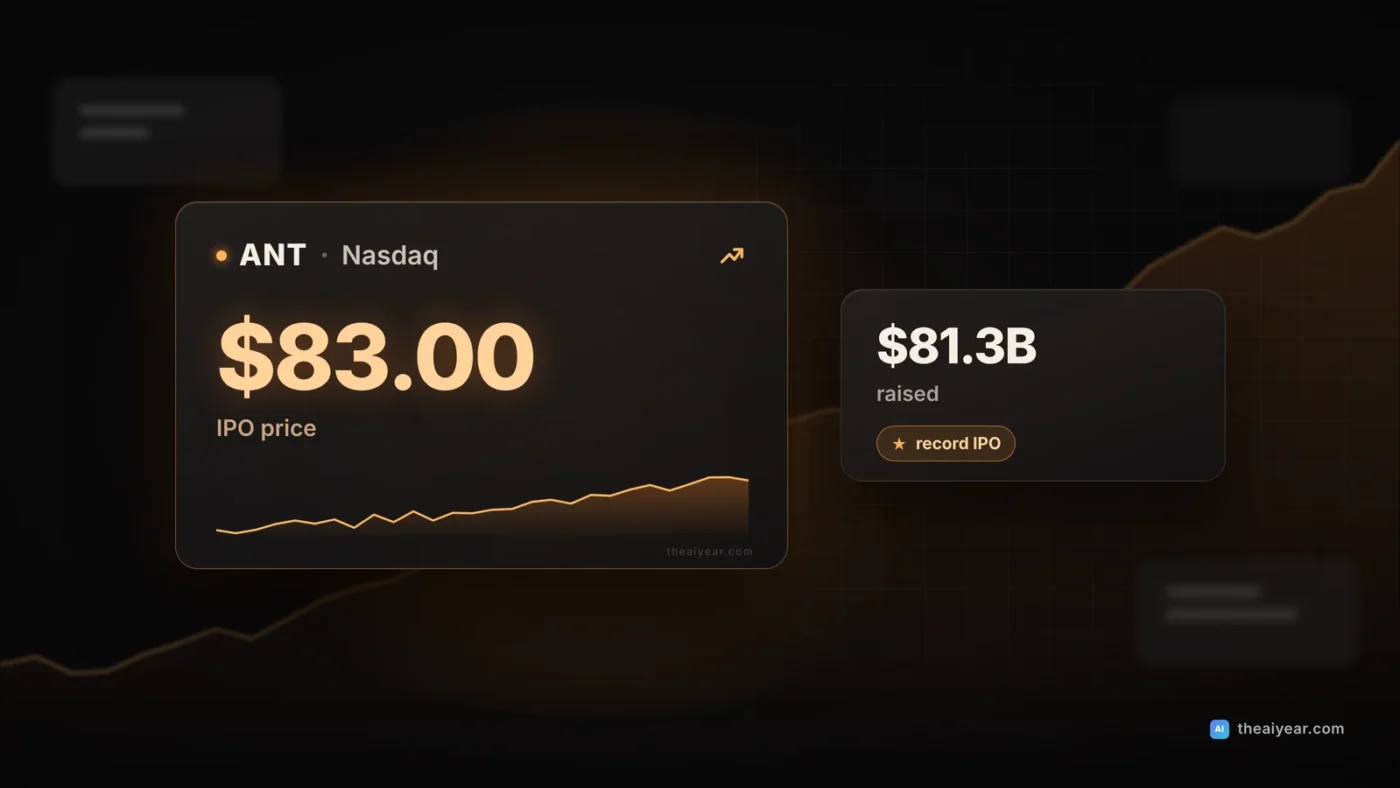
Anthropic priced its initial public offering at $83 a share on November 18, 2026, above the $70 to $78 range it set last week. The company behind Claude and Claude Code sold 980 million shares and raised about $81.3 billion, the largest IPO on record. Its stock is set to start trading on the Nasdaq Global Select Market today, Thursday, November 19, under the ticker ANT. For teams on Claude, nothing changes in your API account today. What changes is how much you can learn about the vendor, and the pressure it will be under.
The numbers, from the filings
According to Anthropic’s pricing announcement, the offering is 980,000,000 Class A shares. Anthropic itself is selling 956,351,354 of them, and existing stockholders are selling the other 23,648,646. Anthropic gets no money from the stockholder sales. The underwriters have a 30-day option to buy up to 147 million more shares, and the deal is expected to close on November 20.
NPR reports that the company’s own share sale brings in about $79.4 billion, and the full deal tops $81.3 billion. That beats the $75 billion SpaceX raised in its June IPO, though CNBC notes SpaceX’s total reached $85.7 billion after its underwriters bought extra shares.
A few more figures worth knowing:
- Upsized deal. Reuters reports the offering grew about 19% from the 825 million shares Anthropic first planned to sell.
- Valuation. About $1.5 trillion fully diluted and about $1.1 trillion on a non-diluted basis, per Reuters.
- Private placement. Anthropic is raising another $26 billion at the IPO price. CNBC says that group of investors includes Google, Microsoft, Nvidia and AMD.
- Revenue. The prospectus Anthropic filed with the SEC shows $33.24 billion in revenue for the nine months ended September 30, 2026, up 1,206% from $2.55 billion a year earlier. Net loss over those nine months was $104 billion, which CNBC says came mostly from fair-value changes on convertible notes and derivatives, not day-to-day operations. The nine-month operating loss was $1.26 billion.
- Run rate. Annualized revenue reached about $81 billion as of October 31, up $10 billion from a month earlier, according to the amended filing cited by Reuters and CNBC. We covered the Q3 numbers when they first appeared in Anthropic’s amended S-1.
As of this writing, ANT has not started trading. Nasdaq opens at 9:30 a.m. Eastern. The Guardian reports that CEO Dario Amodei and his co-founders will ring the opening bell.
Why it matters if you build on Claude
You get real disclosure now
A public company has to file quarterly reports. For Claude customers, this is the most useful part of the IPO. From here on you’ll see revenue, compute spending and risk factors every quarter, signed off under securities law.
The prospectus already tells you a lot. Anthropic says it lost about $600 million in revenue in the third quarter to “price reductions introduced as part of new model versions and contractual discounts.” It also warns it “may be required to reduce our prices, offer shorter contract durations, or offer alternative pricing models, such as outcome- or task-based pricing.” It says its agentic products are “structurally more compute-intensive” than its other offerings. If you run Claude Code or long-running agents, that last line is worth reading twice. The company is telling investors it needs pricing that reflects that cost. Cheaper per-token prices and new ways of charging for agent work can both be true at once.
Compute is the risk to watch
Reuters reports that Anthropic has committed close to $900 billion in compute spending with partners such as Amazon and Google. The prospectus warns that it “may not receive the full amount of compute we seek,” and that problems with its cloud suppliers could cause “delays, service disruptions.” For a developer, that translates to rate limits, capacity crunches and slower rollouts of new models. The IPO cash helps pay for that compute. It doesn’t make the risk go away.
Governance is unusual, and contested
Anthropic is a Delaware public benefit corporation. The prospectus says it must balance shareholder returns with its stated purpose, “the responsible development and maintenance of advanced AI for the long-term benefit of humanity.” A Long-Term Benefit Trust of five financially disinterested trustees elects a majority of the board, and a founders’ LLC holds 50.1% of general voting power. The filing says plainly that this setup limits how much ordinary Class A shareholders can influence big decisions. On paper, earnings pressure can’t override the mission. Whether that holds is another question.
Plenty of people say they won’t. On November 18 the Center for AI Safety published the MisAnthropic Statement, signed by figures including Steven Pinker, Judea Pearl and Max Tegmark. It says “Anthropic is not a safe AI company.” The group points to Anthropic weakening its Responsible Scaling Policy in February and lobbying on state AI bills. Those are the signatories’ claims, and The National reports that at least 80 people signed. Separately, a group called Ban RSI has a rally planned outside Anthropic’s San Francisco office at 500 Howard St. at 11 a.m. Pacific today. It’s protesting the use of AI to build more powerful AI.
Competition gets sharper
Anthropic is the first major frontier AI lab to go public, and CNBC reports that OpenAI has confidentially filed and expects to list in 2027. Reuters cites Ramp data from September showing OpenAI’s GPT-6 Astra with about 13% of tracked enterprise AI spending, against about 8% for Claude Fable. It also cites a Capgemini study in which 59% of large-company executives plan to use more open-weight models. Anthropic’s own filing lists open-weight models as a source of pricing pressure.
What to do this week
- Don’t change vendors because of a stock chart. The share price on day one says nothing about Claude’s uptime or code quality. Make model decisions based on your own evals, not headlines. Our 8-step model selection checklist is a good place to start.
- Mark the earnings calendar. Have someone skim each quarterly report for price changes, compute spending and new risk factors.
- Keep a second model warm. If you’re a Seattle startup or a Chicago agency running everything through one API, put a thin layer between your app and the model, and test a backup provider once a quarter. That protects you from outages and price changes alike.
- Read your contract before renewal. Since Anthropic says it may move to shorter contracts or task-based pricing, ask about price locks, notice periods for rate changes and model deprecation terms now, while you have leverage.
- Check your data settings. Public-company scrutiny doesn’t replace your own admin work. If you manage a Claude team plan, our Claude data admin checklist covers what to review.
Our take: the IPO is good news for Claude customers mainly because it brings disclosure. Anthropic now has to show its numbers every quarter, and that’s worth more to you than whatever the stock does today.
This article is news reporting, not financial advice.