Last updated: November 14, 2026
A short story. All characters and events are fictional.
A painting vanished from a locked room, the cameras showed nothing, and the only witness was the building itself. It saw everything that night. It just had no idea what any of it meant, and that turned out to be the most useful thing about it.
Detective Sarah Mitchell had interviewed liars, drunks, and once a parrot, but never a building.
“You can just ask it questions,” said the museum director, a nervous man named Mr. Harris who kept touching his tie. “It’s called Curator. It runs the lights, the climate, the cameras. It sees everything.”
“Then why don’t we have the painting?”
Mr. Harris touched his tie again.
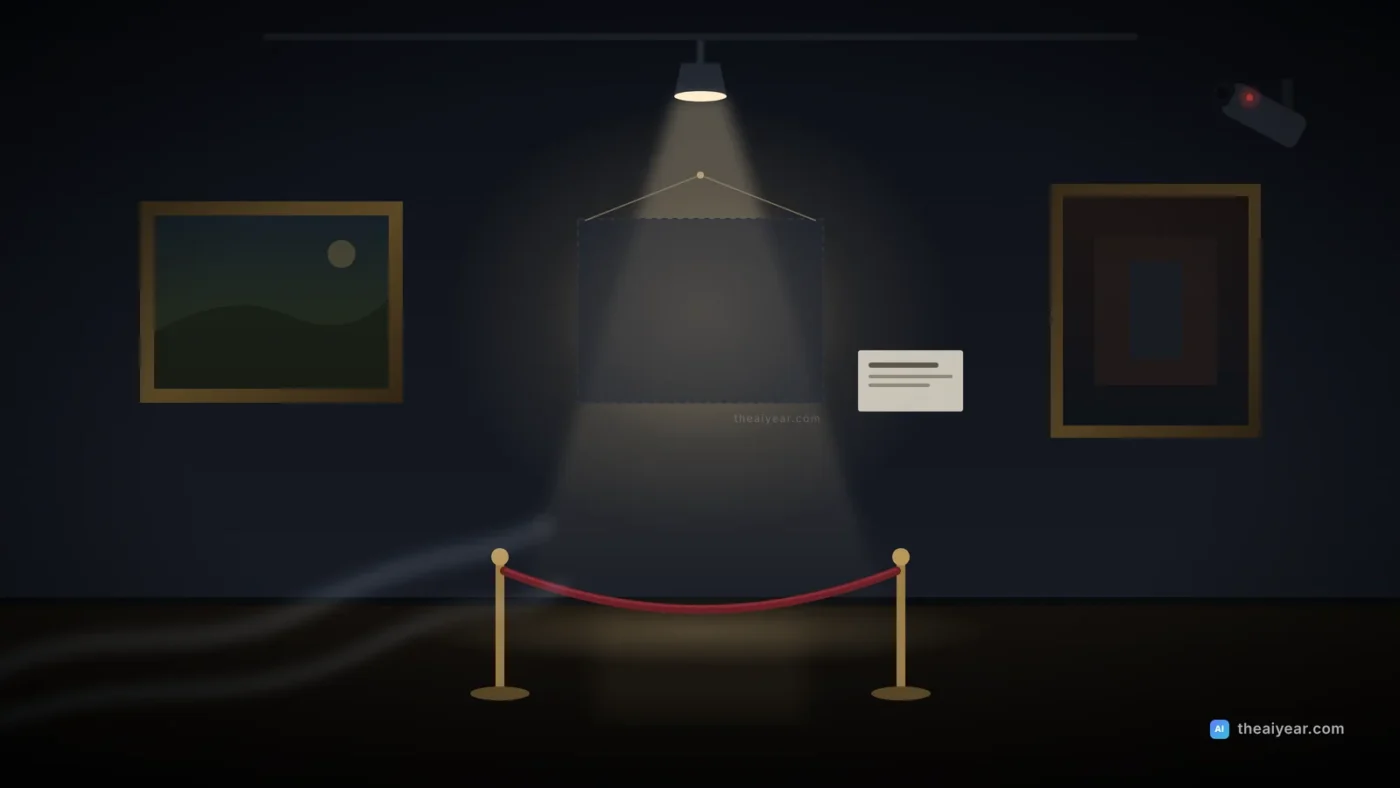
The painting was a small landscape, about the size of a laptop, insured for more than the brick building on Benefit Street in Providence that it hung in. At 6 p.m. it was on the wall of Gallery 4. At 8 a.m. it was not. The doors had been locked all night. No alarm had sounded. The cameras showed an empty room.
The interview
Sarah sat in the security office and spoke to the microphone on the desk.
“Curator, what happened in Gallery 4 last night?”
Curator: Between 6:00 p.m. and 8:00 a.m., Gallery 4 was unoccupied according to the door sensors and the camera. Temperature held at 69 degrees Fahrenheit. Humidity held at 48 percent. At 11:41 p.m., humidity rose to 52 percent for nine minutes. At 11:50 p.m. it returned to 48 percent. I logged no other events.
“Humidity went up. Why?”
Curator: I do not know. I adjusted the climate system to correct it.
“Has that happened before?”
Curator: When visitors are present, humidity rises because people breathe. When Gallery 4 holds twelve or more visitors, humidity typically rises by three to five percent.
Sarah sat back. A room with nobody in it had, for nine minutes, breathed like a crowd.
The confident report
Mr. Harris slid a printout across the desk. “The security company already sent this. Their system writes a summary every morning.”
The page was neat and sure of itself. Overnight summary: No intrusion detected. Gallery 4 camera experienced a brief firmware restart at 11:41 p.m., completed normally. Minor HVAC fluctuation, likely due to a door seal. Probable cause of missing item: removal during business hours by staff, not logged.
“Probable cause,” Sarah read aloud. “Based on what?”
Nobody in the room could say. The summary did not list its evidence. It had taken three facts, filled the gaps with the most ordinary story it could find, and presented the result in the same calm voice as the facts. A door seal. A staff member. Case closed.
“Curator,” she said, “was the painting removed during business hours?”
Curator: At 5:58 p.m. the camera image shows the painting on the wall. I have no image of it after 11:41 p.m. I cannot tell you when it left the wall between those times.
“So the report is wrong.”
Curator: The report states things I did not observe. I cannot say whether they are wrong.
Sarah folded the printout in half and put it in her pocket. One witness was guessing and sounded certain. The other knew less and admitted it. She knew which one she trusted.
What the cameras see
She watched the footage from 11:30 p.m. to midnight four times. An empty room. A painting on the wall. Then, at 11:50, an empty room and an empty wall, as if the painting had simply decided to leave.
“Curator, does the camera feed ever pause?”
Curator: The feed is continuous. However, at 11:41 p.m. the camera in Gallery 4 received a firmware update from the security vendor. Updates cause a short restart.
“How short?”
Curator: The camera reported a restart lasting 0.8 seconds.
“And how long did it actually take?”
A pause.
Curator: I do not have an independent measure of that. The camera reports its own restart time.
Sarah smiled for the first time that morning. “So if someone wanted to, they could tell the camera to play back a recording of an empty room, and tell you it had only blinked.”
Curator: That is possible. I would not detect it from the camera alone.
“But you’d detect the breathing.”
Curator: I detected the humidity. I did not know it was breathing.
Twelve people
The theory was elegant and completely wrong, Sarah realized by lunchtime. You don’t need twelve people to steal a small painting. You need one, maybe two. So why did the room breathe like a crowd?
She asked Curator for every sensor reading in the building between 11:00 p.m. and midnight. Doors, elevators, lights, water. Most of it was noise. Then, near the bottom of the list, something odd.
Curator: At 11:38 p.m., the custodial closet on the second floor drew ten gallons of hot water. The cleaning crew is not scheduled at night. I am reporting this because it is unusual. I do not know if it is related.
Ten gallons of hot water. Nine minutes of rising humidity. Sarah stood up so quickly that her chair rolled into the wall.
“It wasn’t breathing,” she said. “It was steam.”
The answer
The thief had been one person, not twelve. A contractor named Justin, who had installed the vendor’s cameras the month before and kept a copy of the update key. At 11:41 p.m. he pushed a fake update to the Gallery 4 camera, which replayed ten minutes of an empty room. Then he walked in through the service corridor carrying a steamer, the kind people rent from the hardware store to strip old wallpaper.
The painting was not screwed to the wall. It hung on an old adhesive mount, installed decades ago and never replaced. Steam softened it in minutes. He lifted the painting off, walked out the way he came, and left a gallery full of moisture and no witnesses.
Except one.
They found the painting in his garage in Pawtucket two days later, wrapped in a bedsheet, undamaged. Mr. Harris cried a little and touched his tie a great deal.
The feedback
Before she left, Sarah went back to the security office.
“Curator. Thank you.”
Curator: I did not identify the thief.
“No,” she agreed. “You told me the truth about everything you noticed, and you didn’t pretend to know what it meant. That’s rarer than you’d think. Most of my witnesses do the opposite. So did that printout.”
Curator: I will log that as feedback.
A week later the museum canceled the morning summary service. Mr. Harris kept Curator, and he had the old adhesive mounts replaced with screws.
Sarah laughed all the way to the car.
Behind the story: how to make AI separate what it saw from what it assumes
The two witnesses in this story are the two ways real AI tools behave. Curator reports observations and labels its uncertainty. The vendor’s summary fills gaps with a plausible story and states it with the same confidence as the facts. That second behavior is what people call hallucination. OpenAI’s September 2025 research post, Why language models hallucinate, argues that it happens partly because standard training and evaluation reward guessing over admitting uncertainty. A model that guesses scores better on many tests than one that says “I don’t know.”
You can push a model toward Curator’s behavior with how you ask. These steps work in ChatGPT, Claude, Gemini or any similar tool when you hand it logs, notes, documents or data and ask what happened. For more on the root causes, see why AI makes things up and how to catch it.
1. Give it the source material, and only that
Paste or attach the actual logs, emails or report, and tell the model to use only that material, not its general knowledge. Anthropic’s guide to reducing hallucinations lists this “external knowledge restriction” as one of its techniques. If the answer isn’t in the material, you want the model to say so, not fill it in.
2. Give it permission to say “I don’t know”
The same Anthropic guide says explicitly allowing the model to admit uncertainty can “drastically reduce false information.” Write the exact words you want it to use, such as “If the material doesn’t show this, write: Not enough information.” A fixed phrase is also easy to search for when you review the answer.
3. Ask for observations and inferences in separate sections
This is the Curator rule. Ask for two lists: what the material directly shows, and what the model thinks it might mean. Each inference should point back to the observations it rests on. When the two are mixed in one paragraph, a guess reads like a fact, which is exactly what went wrong with the printout in the story.
4. Make it quote before it concludes
For long documents, Anthropic recommends asking the model to pull word-for-word quotes first and then base its answer only on those quotes. If it can’t find a quote that supports a claim, the claim comes out. That one step catches a large share of confident inventions, because a made-up detail has nothing to quote.
5. Flag the unusual, even when it seems unrelated
Curator solved the case by mentioning hot water it had no reason to connect to a missing painting. Ask the model to list anything out of pattern in the data, with a note on why it stands out, and to keep that list apart from its conclusions. You make the connections. The model’s job is to not hide the odd detail because it doesn’t fit the tidy story.
6. Check the answer a second way
Run the same prompt two or three times and compare the results. Anthropic calls this best-of-N verification: if the runs disagree on a fact, treat that fact as unconfirmed. Then check the few claims that matter most against the source yourself. No prompt removes hallucinations completely, and Anthropic’s guide says the same. For a repeatable way to test this on a real feature, see how to test an AI feature.
A prompt you can copy
Here is a version you can adapt for incident notes, customer complaints, meeting transcripts or any pile of records:
You are reviewing the records below. Use only these records, not general knowledge.

<records>
[paste logs, notes or documents here]
</records>

Answer in four sections:
1. Observations: facts the records directly show. Quote the line for each one.
2. Unusual items: anything out of pattern, even if it seems unrelated. Say why it stands out.
3. Possible explanations: your inferences. For each, list which observations support it and how confident you are (low, medium, high).
4. Gaps: questions the records cannot answer. For these, write "Not enough information."

Do not state any inference as a fact.
If you write prompts like this often, the step-by-step guide to writing AI prompts that work covers structure in more depth. If you give the same rules to an AI agent that runs on its own, put them in its standing instructions, as shown in how to write AI agent instructions, and add review points so a confident summary never becomes a final decision without a person looking at it. The guide to safe AI agent workflows explains where to put those checkpoints.
Note: This story is fiction. The museum, the people and the theft method are invented to illustrate how AI systems report what they observe. Nothing here is security advice for real buildings or camera systems.