OpenAI says an AI pipeline built around an unreleased “cyber model” found, reproduced and wrote working exploits for 948 distinct Linux kernel bugs in a single run in mid-October. Each one lets an ordinary local user become root. The company published the results on November 4 in a research post titled “A thousand fewer paths to root”, and by Thursday morning it was among the most discussed stories on Hacker News.
The headline number is startling, but the more useful part is what it says about patch speed, cost and the systems you actually run. Here’s what OpenAI reported, what it didn’t, and what Linux admins and developers should take from it.
What OpenAI says it did
OpenAI describes a five-stage prototype that ran in what it calls a controlled research environment. It doesn’t name the model, only “an upcoming cyber model.” According to the OpenAI post:
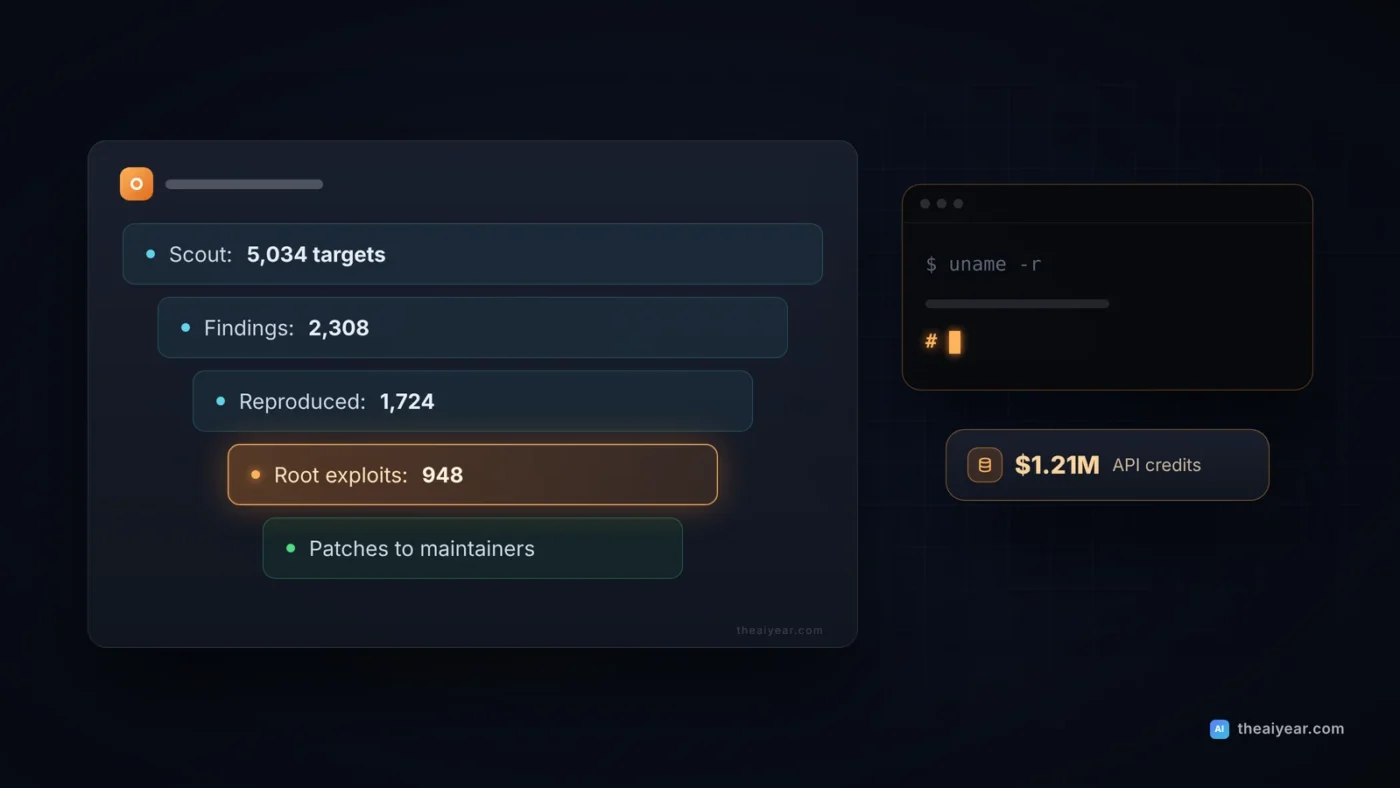
- Scouting: agents narrowed the kernel’s more than 40 million lines to 5,034 audit targets, about 2.8 million lines or roughly 7% of the code, picking the parts an unprivileged user can reach. Cost: $3,426 in API credits.
- Analysis: analyst agents produced 2,308 candidate findings in 12 hours, for $316,549.
- Validation: agents reproduced 1,724 of them, about 74.7%, inside isolated virtual machines within 30 hours. OpenAI says only 3.1% reflected incorrect analysis by the model.
- Exploitability: agents produced 291 information-leak proofs of concept and 1,169 working privilege-escalation exploits. Variant analysis grouped those into 948 distinct bugs, each with its own candidate patch.
- Human review: security researchers checked exploits, patches and severity before anything went to kernel maintainers.
The whole run cost $1,213,430 in API credits, or about $1,279 per unique root exploit. The targets were stock desktop installs of “a commonly used Linux distribution” with standard protections such as KASLR, SMEP and SMAP turned on, not a deliberately weakened kernel. OpenAI also says that, to its knowledge, the agents used at least 10 exploitation techniques that were new to outside kernel experts. It withheld the details of those techniques for safety reasons.
Independent coverage from Interesting Engineering and Cyber Security News matches these figures. All of them come from OpenAI’s own write-up, though, and no outside group has audited the run yet.
What the number doesn’t mean
Three things are easy to misread.
It’s not 948 fixed bugs. These are candidate patches. OpenAI says that, following the kernel community’s guidance, it has sent “hundreds of reports and patches for critical vulnerabilities” and is working with partners in its Patch the Planet program to send the rest gradually. By the time the 10-day scan and review finished, 61 of the bugs had already been patched upstream, 43 had staging patches, and 299 were being reported and discussed publicly, many of them by other contributors.
It’s not remote hacking. Every one of these is a local privilege escalation. An attacker first needs some foothold, such as a low-privilege account, a compromised web app or a container. The bugs turn that foothold into full control of the machine.
It’s not a product you can buy. The model is unreleased and the pipeline is described as a research prototype. OpenAI also frames the costs as an upper bound, saying better engineering could cut them substantially.
Why it matters
The economics changed. OpenAI compares the run to historical Linux kernel bounties at Pwn2Own ($20,000) and TyphoonPWN ($70,000). Priced that way, the 948 exploits would be worth $18.9 million to $66.3 million, 16 to 55 times what the run cost. That’s OpenAI’s hypothetical, not real payouts, but the direction is clear: finding a kernel root bug used to take a skilled researcher weeks, and here it averaged a little over a thousand dollars of compute.
Models are also improving fast at this. OpenAI says a July run with GPT-5.6 Sol found 166 unique root exploits for $513,690. The October run found more than five times as many, even after three months of kernel hardening between the two scans.
The sentence from OpenAI’s post that matters most for anyone running Linux is this one: for the near and medium term, a low-privileged account on a system that “isn’t up-to-date on its latest available patches should be considered functionally equivalent to root access for a well-resourced threat actor.”
We’ve already seen how fast disclosure turns into attacks this year. Both PHP2Shell in PHP and HTTP2Shell in Node.js and Python went from public bug to active exploitation, and teams that patched slowly paid for it. The kernel run points the same way at a much bigger scale, and an attacker’s version of these tools won’t wait for a coordinated disclosure program.
What to do this week
None of this calls for panic, and OpenAI hasn’t published exploit details. It does argue for tightening a few habits, most of which OpenAI itself recommends:
- Shorten your kernel patch window. Fixes are landing upstream quickly, but they only help once your distribution ships them and your machines reboot into the new kernel. If kernel updates sit in a quarterly maintenance window, that gap is now the risk. Live-patching services from your distribution vendor can help where reboots are hard.
- Treat shared Linux hosts as shared root. Build servers, CI runners, jump boxes, shared dev servers and multi-tenant VMs give many people a local account. Assume any unpatched one can be fully taken over by anyone with a shell on it, and limit who gets one.
- Remember that containers share the kernel. A container escape via a kernel bug is a local privilege escalation. For untrusted or customer-supplied code, OpenAI points to stronger isolation such as gVisor or Firecracker microVMs instead of plain containers.
- Apply the same thinking to AI agents. If you let coding agents or automation run shell commands on a server, that’s a local foothold too. Run them in throwaway sandboxes with minimal access, as we lay out in our guide to designing safe AI agent workflows.
- Expect a heavier patch stream. Kernel and distribution teams are absorbing hundreds of reports at once. Budget for more frequent updates over the next few months instead of treating each one as a fire drill.
Our take
This is a defensive announcement with an uncomfortable subtext. OpenAI ran it the responsible way: human review, maintainers first and exploit techniques withheld. But the post also admits that “even less capable models may be able to develop exploits once disclosed,” and that the bottleneck is no longer finding bugs but validating, prioritizing and patching them. The Linux community clearly moved fast here, with 104 of the bugs fixed or in staging within 10 days.
The weak point is everyone downstream. A fixed bug in the kernel tree does nothing for a server that hasn’t rebooted since summer. If your organization still treats kernel updates as optional housekeeping, this is the week to change that.