Last updated: November 13, 2026
A short story. All characters and events are fictional.
Some of the most useful things an AI can do are small: read a faded word, and admit when it’s only guessing. This is a story about a tired teenager, a shoebox of old love letters, and a grandmother who remembered far more than anyone thought to ask.
Grandma asked the same question four times before dinner.
“Has your father called?”
“Not yet, Grandma.”
Ten minutes later: “Has your father called?”
Zoe was seventeen and had finals in three weeks. She loved her grandmother more than almost anyone, and by the fourth time she said “Not yet, Grandma,” her voice had an edge she immediately hated.
Grandma heard it. Grandma always heard it. She went quiet and looked at her hands, the way she did when she knew she had done something wrong but could not remember what.
Zoe’s father was on a pipeline job in North Dakota and called on Sundays. It was Wednesday. Zoe knew that. Grandma had known it too, once.
The box under the bed
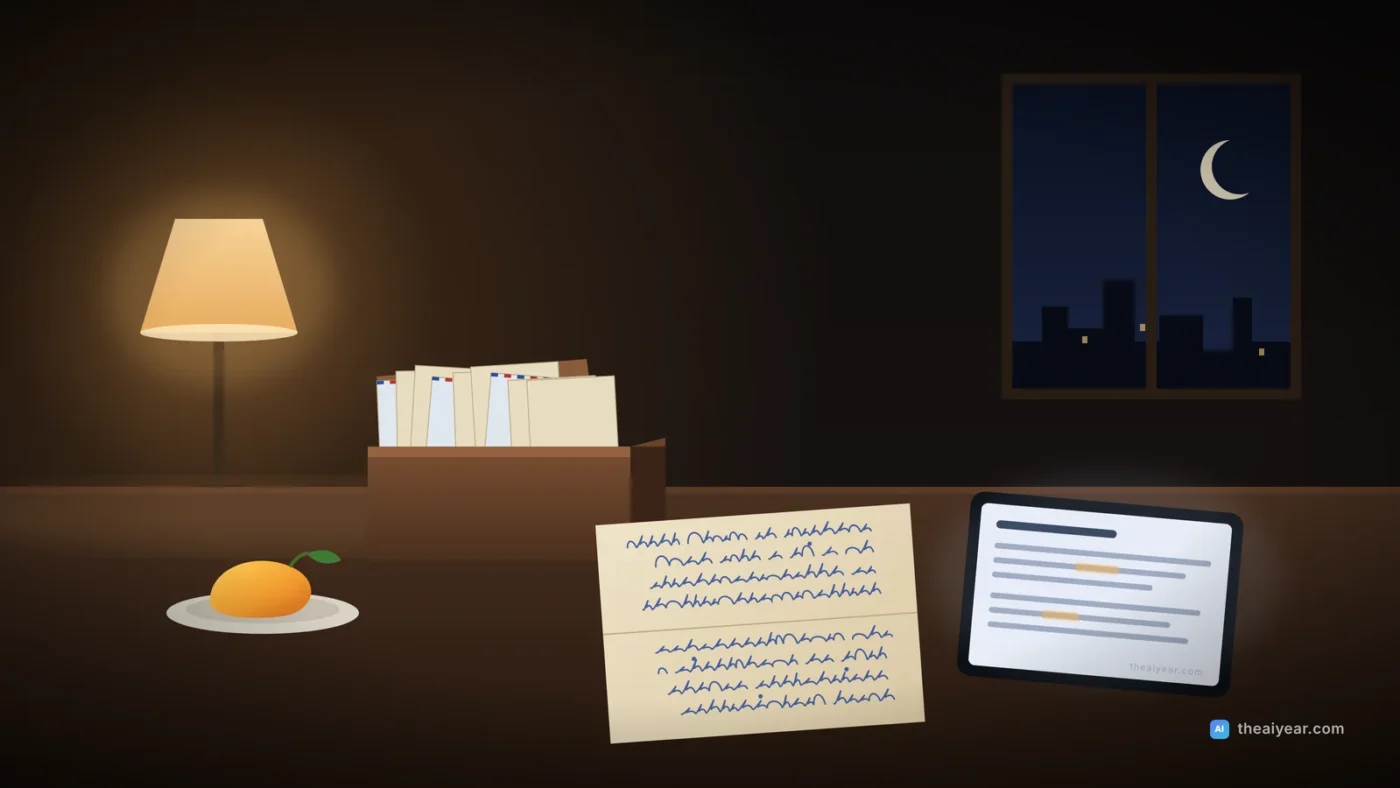
The doctor had said routine helped. Familiar things. So on Saturday Zoe’s mother pulled a shoebox from under Grandma’s bed, full of letters. Fifty years of them. Letters from Grandpa when he worked in Chicago and she stayed in their small town in Indiana with three children. Letters in looping blue cursive, some so faded they were almost gone.
“She used to read these to me when I was small,” her mother said. “She knew some of them by heart.”
Grandma could no longer read them. Her eyes were tired, and the words slid around on the page. Zoe could read cursive, slowly, but Grandpa’s handwriting was a code she could not crack. Every lowercase m looked like a fence.
That evening, mostly to avoid studying for chemistry, Zoe took a photo of one letter and gave it to an AI app on her phone, asking it to read the handwriting and type it out exactly, and to mark any word it wasn’t sure about.
It got most of it. Not all. Where it was unsure, it put the word in brackets with a question mark. “The peaches this year are [very sweet?] and I thought of you at every one.”
Zoe laughed out loud. Grandpa had written a love letter about peaches.
The evenings
She began doing it every night after dinner. One letter at a time. She would photograph it, let the app transcribe it, correct what she could, and then read it aloud to Grandma from the old tablet, in big letters, sitting on the edge of her bed.
Something strange happened. Grandma could not remember whether Zoe’s father had called. But she remembered the peaches.
“He brought a whole crate on the bus,” she said, eyes bright. “The driver wanted to charge him for an extra seat. Your Grandpa argued for twenty minutes. He paid in the end. He always paid in the end.”
Zoe wrote that down too.
Some nights the app got words wrong and Grandma corrected it, sharp as anything. “Not cookies. Cobbler. He was always writing about food, that man.” Some nights she cried, quietly, at a line about a baby’s fever, a baby who turned out to be Zoe’s mother. Some nights she fell asleep halfway through, smiling.
She still asked whether Zoe’s father had called. Zoe still answered. But the edge in her voice had gone, and she was not sure exactly when.
The wrong name
The mistake that scared her was one the app didn’t flag.
In the ninth letter, it typed, cleanly and with no brackets at all: “Tell Aunt Ruth the roof is fixed and she can stop worrying.” Zoe read it aloud. Grandma frowned.
“Ruby,” she said. “Aunt Ruby. Ruth was his mother, and she’d have skinned him for calling her aunt.”
Zoe looked at the photo again. Once she knew, it was obvious: a tail on the last letter that the app had read as an h. The app had been sure, and it had been wrong, and if Grandma had been asleep that night, Aunt Ruby would have quietly turned into somebody else in the family record.
After that she made herself a rule. The brackets told her where to look, but she checked every name, date and place against the page herself, letter by letter, no matter how confident the typed version looked. It slowed her down by about ten minutes a night. She decided Aunt Ruby was worth ten minutes.
Where the pictures go
Her mother noticed the routine on the second week and asked a question Zoe hadn’t thought about.
“Those photos you’re taking. Where do they go?”
Zoe didn’t know. So they sat at the kitchen table and read the app’s privacy settings together, which took longer than either expected. They turned off the setting that let the company use her chats to improve its models. They found one letter with Grandpa’s old bank account number written across the bottom, and Zoe put a sticky note over that line before she took the picture. Nobody needed the number. Everybody needed the peaches.
Forty-one letters
By the end of finals, there were forty-one transcribed letters in a folder on the tablet, each one saved next to the photo it came from and named with the date Grandpa wrote it. Zoe had added notes beneath each one: the stories Grandma told when she heard them. The crate of peaches. The bus driver. Aunt Ruby’s roof. The year the river flooded and Grandpa walked seven miles to send a telegram that just said “Safe.”
Her mother read the folder one night and did not speak for a long time.
“I didn’t know half of this,” she said finally.
“Neither did I,” said Zoe. “I think she’s been waiting for someone to ask.”
The next morning her mother copied the folder onto a thumb drive for the kitchen drawer and emailed another copy to Zoe’s Uncle Dave in Ohio, who called that night and talked to Grandma for an hour about a dog named Biscuit that nobody else remembered.
What the machine could not do
It would be easy to say the app saved something. It didn’t, exactly. It could read faded ink faster than a tired teenager. It could guess at a word and, most of the time, admit when it was guessing. That was all.
What it could not do was sit on the edge of the bed. It could not hear the change in Grandma’s breathing when she reached a line she loved. It could not decide, on a bad night, to skip a sad letter and read the one about peaches again.
Zoe did that part.
On the last night of the summer, before she left for college, she read the final letter in the box. It was short.
“Whatever happens to us, the children will remember. That is enough.”
Grandma was quiet for a while. Then she reached over and patted Zoe’s hand.
“Has your father called?” she asked.
“Not yet, Grandma,” Zoe said gently. “But I’m here.”
Behind the story: how to transcribe family letters with AI
Zoe and her grandmother are made up, but the project is real and within reach for almost any family. Current AI chat apps can read many handwritten pages from a phone photo. What makes the result worth keeping is the same thing that made Zoe’s folder worth keeping: careful handling of the originals, a faithful transcription, and a person who checks the parts that matter. Here’s a simple way to do it, drawn from guidance by the Library of Congress and the National Archives.
1. Protect the originals first
The National Archives’ tips for handling family papers are short and practical: clear a clean space first, keep food and drinks away, and wash your hands without putting on lotion afterward. Paper can be handled without gloves, while photographs should be handled with gloves. Its digitizing guide warns that automatic-feed scanners aren’t suitable for fragile or valuable papers, and that you should keep the originals after you digitize them, because digital files can be lost too. A phone photo in good daylight, flat on a table, is often enough for transcription.
2. Decide what you’re willing to upload
Before you send a single page to an AI app, read its privacy settings. Google’s Gemini Apps privacy notice, for example, says human reviewers see some data and asks users not to enter confidential information they wouldn’t want a reviewer to see or Google to use to improve its services. Other apps have their own settings for training and chat history, so check the one you use. Cover account numbers, Social Security numbers and anything else that could be misused, as Zoe did with a sticky note. Our guide to using AI without leaking sensitive data covers the same habits for work files.
3. Ask for a faithful copy, not a cleanup
An AI app will happily “fix” old spelling and smooth out awkward sentences unless you tell it not to. The Library of Congress’s volunteer transcription program, By the People, has clear basic rules: keep the original spelling, grammar and punctuation, don’t paraphrase, and put [?] in place of words you can’t read. Borrow those rules for your prompt. Something like this works well:
Transcribe this handwritten letter exactly as written.
Keep the original spelling, grammar and punctuation. Do not
correct or modernize anything. Keep the line breaks.
If you are unsure of a word, write your best guess followed
by [?]. If you cannot read a word at all, write [?].
After the transcription, list every name, date and place
you found, and mark any you are not sure about.
The last two lines matter most: they give you a short list to check. For more on writing instructions like this, see how to write AI prompts that work.
4. Check names, dates, places and numbers yourself
Like Zoe’s “Aunt Ruth,” the most damaging errors are often confident ones the tool didn’t flag. Read the names, dates, places and figures against the original image, one by one, even when there are no brackets. The Library of Congress page on reading cursive handwriting has helpful tips, such as counting downstrokes when letters like i, n and m run together, and it notes that the plainer Palmer Method was popular from the late 19th to the mid-20th century, which may match the letters in your own family’s box. Our explainer on why AI makes things up explains why a fluent answer can still be wrong.
5. Label, store and back up
Save each transcription next to the image it came from and give both the same file name. The National Archives suggests adding basic who, what, where and when details to your files and following the 3-2-1 rule: three copies, on two different kinds of media, with one copy stored somewhere else. The Library of Congress’s personal digital archiving pages give similar advice for photos and documents, including making at least two copies and keeping them in different places.
6. Write down the stories, too
The letters were only half of what Zoe saved. The other half was what her grandmother said when she heard them. If you’re reading old letters with a relative, keep a notebook or a voice memo running (with their permission) and save those notes alongside the transcriptions. A typed letter tells you what happened. The person who lived it tells you why it mattered.
This story is fiction. Zoe, her family and the letters are made up. The practical section is general guidance on preserving family documents, not medical, legal or privacy advice. If someone you love is living with memory loss, their doctor is the right person to ask about care and routines.