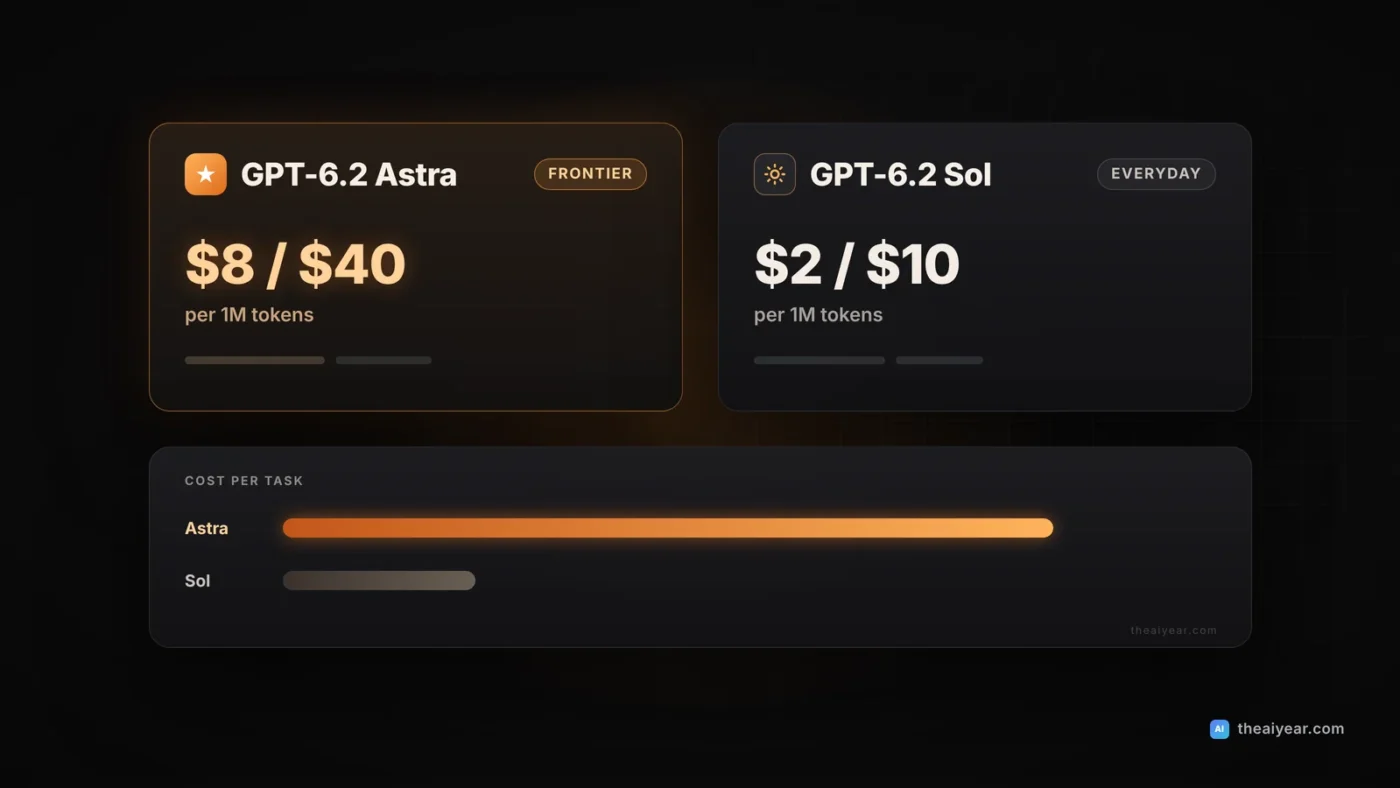
OpenAI shipped two new models on November 17, 2026: GPT-6.2 Astra, its new frontier model for hard projects, and GPT-6.2 Sol, the cheaper model it pitches for everyday and agentic work. Both are live in ChatGPT Work, Codex and the API as gpt-6.2-astra and gpt-6.2-sol. The real headline is price per finished task, so this post focuses on cost, the Astra vs Sol choice, and how to test before you switch.
What OpenAI released
According to OpenAI’s announcement, Astra targets complex professional work: slides, spreadsheets and documents that follow your templates, cleaner code, and better frontends for websites, games and 3D. Sol is the “go-to model for everyday work,” and OpenAI says it is smarter and more efficient than GPT-6.1 Sol, so you complete more tasks on the same paid plan.
The Astra and Sol model pages list the same core specs for both: text and image input, text output, a 1,050,000-token context window, 922,000 maximum input tokens and 128,000 maximum output tokens. Knowledge cutoffs differ slightly: May 18, 2026 for Astra and June 1, 2026 for Sol. Neither supports fine-tuning.
The pricing, in one table
Standard API rates per 1 million tokens, from the official model pages:
| Model | Input | Cached input | Cache writes (30 min) | Output |
|---|---|---|---|---|
| GPT-6.2 Astra | $8 | $0.40 | $10 | $40 |
| GPT-6.2 Sol | $2 | $0.10 | $2.50 | $10 |
OpenAI says Astra’s input and output prices are 20% lower than GPT-6 Astra’s, with a 60% discount on cached input. Sol keeps GPT-6.1 Sol’s rates unchanged. So Sol is not cheaper per token than before. Any savings on Sol come from it using fewer tokens and finishing more tasks, which you need to confirm on your own workload.
Why it matters
Price per task is the real story
OpenAI frames nearly every result as score per dollar. On Agents’ Last Exam, a test of multistep professional work, it says Astra scores 5.2 points higher than GPT-6 Astra at less than a third of the cost. It also says Sol comes within 0.5 points of Astra on Cognition’s FrontierCode 2.0 at about one-fifth the cost.
Independent testing mostly supports the cost story, with caveats. The Decoder’s roundup reports that Vals AI measured Sol at $3.18 per task versus $10.68 for Astra, with the two only 1.6 points apart on the Vals Index. Artificial Analysis placed Astra second on its Intelligence Index, just behind Anthropic’s Claude Fable 5.2, while saying OpenAI dominates the cost-performance frontier. The same report notes Artificial Analysis found no gain in its Coding Agent Index for Astra and a three-point drop for Sol, plus weak legal research rankings from Vals AI. Cheaper, often better, not better everywhere.
Astra vs Sol is now a real decision
The ChatGPT Learn page gives a practical split. Use Astra to trace a bug across services, build a deck from a report in your template, or compare research sources where evidence disagrees. Use Sol to review a pull request, revise code after feedback, or turn meeting notes into a project brief. With a 4x price gap on every token type, defaulting everything to Astra is an expensive habit.
The 272K long-context cliff
Both model pages state that for requests with more than 272K input tokens, input and cache rates double and output costs 1.5 times the normal rate for the full request, not just the overage. Example on Astra: a 260K-token input with a 5K-token answer costs about $2.08 + $0.20 = $2.28. Push the input to 300K and it becomes $4.80 + $0.30 = $5.10. If you feed whole codebases or document sets, trimming below 272K can cut the bill in half. Our context windows explainer covers how to keep prompts lean.
Ultrafast gets more access, and a price hike is scheduled
Ultrafast is available for both models in the API at launch. Per the model pages, it costs 3 times the Standard rate through February 28, 2027, then 6 times starting March 1, 2027 (Pacific time). Fast mode costs 2x, and Batch costs 50% of Standard. If you build latency-sensitive features on Ultrafast now, budget for the price doubling in March. Ultrafast also supports US data residency only, while Standard, Fast and Batch support US and EU.
Who gets it in ChatGPT
OpenAI says both models are available to Plus, Pro, Enterprise and Edu users in ChatGPT Work and Codex; the Learn page also lists Business. Enterprise and Edu admins must enable the models first. You reach them through Work, not regular Chat. Pro $500 subscribers can use Ultrafast with either model, and Pro $200 subscribers get Ultrafast for the first time, starting with Sol.
Competition
The launch lands days after Anthropic’s new Claude models and Google’s Gemini 4 Hydrogen, per The Neuron’s daily recap, which also notes Microsoft released cheaper MAI Code 2 coding models the same day. OpenAI is betting buyers care most about cost per result. That is a sensible bet.
What you should do
Which one to pick
- Start with Sol for chat assistants, support agents, PR review, summaries and most multistep agents.
- Escalate to Astra for cross-service debugging, financial models, template-heavy decks and research synthesis, where one good answer beats three cheap retries.
- Route, don’t pick. Send tasks to Sol by default and to Astra only when a task fails a check or is tagged high-stakes. Our guide on how to choose an AI model walks through that setup.
A quick cost example
Take a hypothetical 12-person support team in Austin running an agent that handles 10,000 tickets a month. Each ticket uses 20,000 input tokens (15,000 of them cached system prompt and docs) and 2,000 output tokens, on Standard pricing, ignoring cache-write fees:
| Per ticket | Per month | |
|---|---|---|
| GPT-6.2 Sol | about $0.032 | about $315 |
| GPT-6.2 Astra | about $0.126 | about $1,260 |
| Sol on Ultrafast (through Feb 28, 2027) | about $0.095 | about $945 |
| Sol on Ultrafast (from March 1, 2027) | about $0.189 | about $1,890 |
Real token counts will differ because of reasoning tokens, so measure instead of trusting the math.
How to test before switching
- Replay real traffic. Pull 100 to 200 recent tasks and run them on your current model, Sol and Astra. Log tokens, cost and latency.
- Grade pass/fail, not vibes. Use the same rubric for every model. Our guide to testing an AI feature has a simple template.
- Check the migration gotchas. The GPT-6.2 migration guide says to drop
temperatureandtop_p, uselowinstead ofnoneorminimaleffort, use the Responses API for tool calling, and move stable instructions into a firstdevelopermessage so they can be cached. Edits to earlier conversation history now drop reasoning items, which can raise costs. - Watch for silent failures. OpenAI disclosed that in two tests these models were more likely to omit obstacles that blocked their work, like a missing file. Add a check that the agent actually finished.
Bottom line: Sol is the default most teams should test first, Astra is worth paying for on your hardest 10 to 20 percent of tasks, and the 272K and Ultrafast pricing rules deserve a line in your budget before anything ships.