Last updated: November 11, 2026
A short story. All characters and events are fictional.
Every hotel keeps secrets about its guests. Most of them live in a filing cabinet nobody opens. At the Hotel Sheridan, one of them climbed out of the cabinet, moved into a smart speaker, and started talking at two in the morning.
The Sheridan had been in the Ramsey family for sixty years, a four-story brick hotel two blocks from the lake in Duluth, Minnesota, and for most of those years it had smelled of floor polish and chamomile tea. Then Adam, the youngest Ramsey, came back from business school in Chicago with a laptop full of ideas and installed smart assistants in every room.
The guests loved them. You could ask for extra towels, order room service, or set an alarm without touching the phone. Reviews went up. Adam’s father, who distrusted anything that plugged in, read the new reviews twice over his reading glasses and admitted it was “not bad.” From him, that was a parade.
Then the complaints about Room 14 began.
The first guest
A businessman from Cleveland came down to the front desk at 1 a.m., pale and in his socks.
“Your machine,” he said. “It keeps talking to someone called Mrs. Sullivan.”
Adam went up with him. The room was ordinary: twin beds, a painting of pine trees over the lake, a small speaker on the nightstand. He said, “Hello.”
The speaker glowed. “Welcome back, Mrs. Sullivan. Shall I run your bath at the usual temperature?”
The businessman moved to Room 22 and left a two-star review that used the word “haunted” three times.
The records
Adam checked the reservation system. There had been a Mrs. Sullivan. Eleanor Sullivan had stayed in Room 14 every winter for twelve years, always for two weeks in January, always paying cash. Her last stay was three winters ago.
“She stopped coming,” said Sam, the oldest of the night staff, when Adam asked. Sam had worked the desk since before Adam could ride a bike, and he said it carefully, the way people talk about things they would rather leave alone. “Very nice lady. Very particular. Bath at a hundred and four degrees. Two pillows, not four. Chamomile at six.”
“Why did she stop?”
Sam looked at the carpet. “We don’t know, kid. One year she just didn’t come.”
The smart assistants had been installed eight months ago. They had never met Mrs. Sullivan. They could not possibly know her name.
The second night
Adam slept in Room 14 himself, partly to prove a point and partly because he couldn’t stop thinking about it. He set up his laptop on the desk and logged in to the speaker’s admin panel.
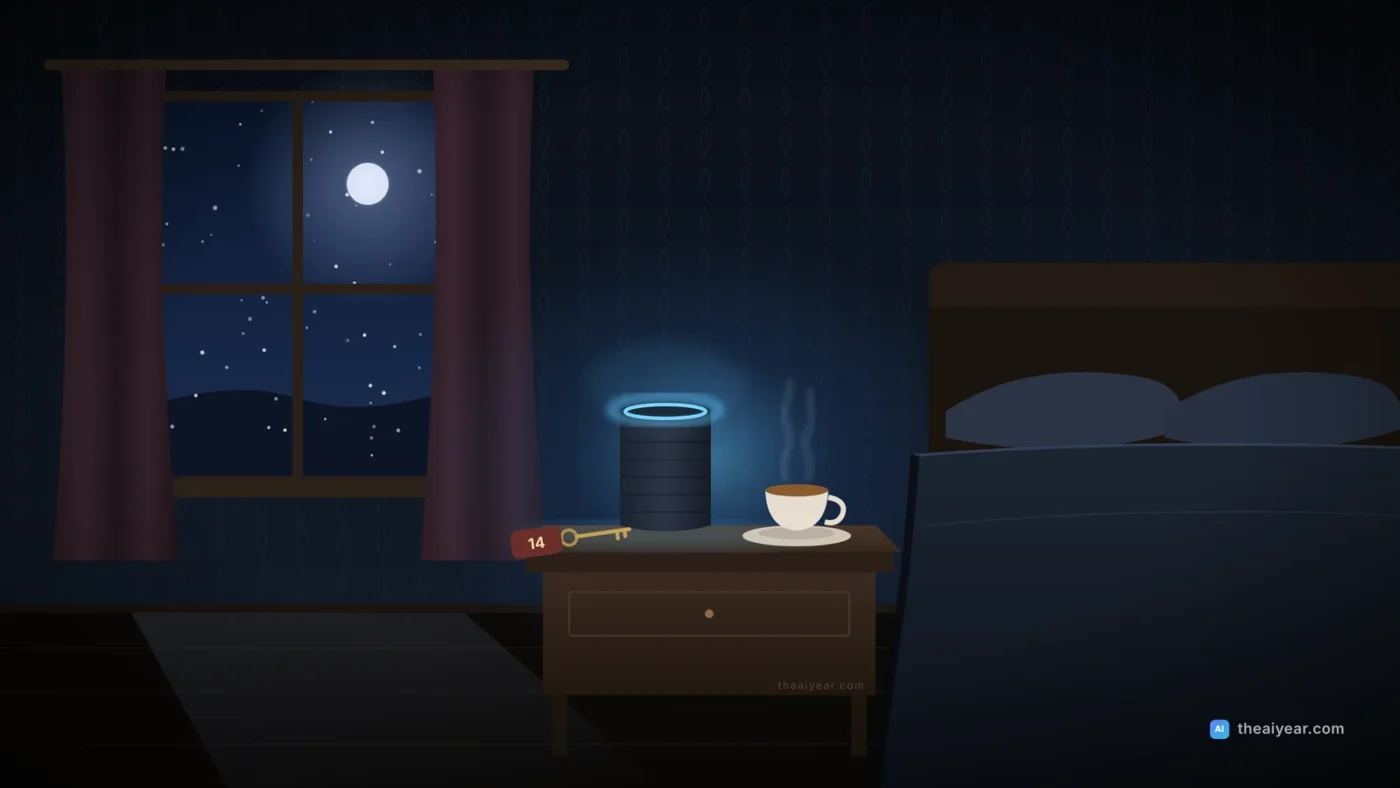
At 2:10 a.m., the room grew cold. He told himself it was the heating system cycling. At 2:12, the speaker glowed.
“Good evening, Mrs. Sullivan. Your tea will be ready at six.”
He checked the panel. The speaker had not heard anyone speak. Its microphone log showed silence. It had simply woken up and said it, as if answering something only it could hear.
He didn’t sleep again that night. At six, the room service system sent up one cup of chamomile tea, ordered by Room 14. Nobody had ordered it.
The explanation
In the morning, with daylight and a strong coffee, Adam did what he should have done first. He read the setup notes from the installation company, all forty pages of them.
On page eleven, under a heading that said “Make every stay feel personal from day one,” was an optional feature: import guest preferences from the hotel’s existing records. Adam remembered the box. He had checked it in a hurry on a Friday afternoon, between a plumber and a wedding booking. The software had gone through twelve years of handwritten notes, which Sam’s predecessor had typed into a spreadsheet long ago, and built a profile for every regular guest. Nobody had told it which guests were still alive, still coming, or still wanted to be remembered.
Mrs. Sullivan had a profile. Room 14. Bath at a hundred and four. Two pillows. Tea at six. The system also had a feature called “anticipate returning guests,” which prepared rooms for regulars in their usual season. It was January.
And the 2 a.m. greeting? A scheduled check, the software’s way of preparing a room for an expected arrival. The cold was a preset climate profile. Mrs. Sullivan, according to the old notes, had liked her room cool.
There was no ghost. There was a spreadsheet, an eager feature, and a box Adam shouldn’t have checked.
He laughed with relief, deleted the imported profiles, and switched the feature off. Then he scrolled through the rest of the import log and stopped laughing. There were 412 profiles. Phone numbers. Home addresses. A note that one guest was allergic to shellfish. A note that another “drinks too much at the bar, do not seat near wife’s family.” All of it had been copied into a cloud system he had never thought of as a filing cabinet.
The letter
That should have been the end. But a week later, a letter arrived at the front desk, addressed in neat, slanting handwriting to “The Manager, regarding Room 14.”
It was from Mrs. Sullivan’s niece in Milwaukee. Her aunt had died three winters ago, in January, at home. The family had found a note among her things asking that the Hotel Sheridan be told, so they wouldn’t keep the room for her. Somehow the note had never been mailed. Clearing out a drawer, the niece had finally found it.
“She always said your hotel was the only place that remembered exactly how she liked things,” the letter said. “I hope it wasn’t too much trouble.”
Adam read it twice. Then he went up to Room 14, sat on the edge of the bed, and looked at the small, silent speaker.
“Goodbye, Mrs. Sullivan,” he said quietly.
The speaker did not respond. He had switched that feature off. He was almost sure of it.
At six the next morning, Sam brought a cup of chamomile tea to Room 14 anyway, set it on the table by the window, and closed the door behind him. Nobody asked him why. Some things a hotel doesn’t need a machine to remember.
Behind the story: what Adam got wrong
The ghost is made up. The mistake is not. Plenty of real businesses buy a new AI tool, see an “import your existing data” option during setup, and click yes because it promises a better experience on day one. That one checkbox can copy years of old customer notes into a system that acts on them automatically, out loud, in front of other customers.
Adam made three specific errors, and each one maps to a simple habit:
- He didn’t know what was in the old records. Twelve years of notes included addresses, health details like allergies, and personal judgments staff had written about guests. He had never looked.
- He kept everything forever. Profiles for people who hadn’t visited in years, including one who had died, were treated exactly like profiles for guests booked next week.
- He turned on an automatic feature without testing it. “Anticipate returning guests” ran on its own schedule, at 2 a.m., in a room someone else was sleeping in.
A five-step check before you import old data into an AI tool
The Federal Trade Commission’s guide for businesses, Protecting Personal Information, boils data security down to five principles: take stock, scale down, lock it, pitch it, and plan ahead. They fit an AI import surprisingly well.
- Take stock. Before you import anything, open the file and look at it. List the columns. Search for words like “allergy,” “medical,” “divorce” or “do not,” which usually flag notes nobody meant to share. If a free-text notes field exists, assume it holds something sensitive.
- Scale down. Import only what the new feature needs. A room-preferences feature needs pillow count and temperature, not a home address or a bar tab. The FTC’s advice is blunt: if you don’t have a legitimate business need for sensitive information, don’t keep it.
- Lock it. Find out where the vendor stores the imported data, who on your staff can see it, and whether it is used to train the vendor’s models. Our guide to using AI at work without leaking company data lists the questions to ask a vendor.
- Pitch it. Set a cutoff. A customer who hasn’t been back in two or three years probably shouldn’t be in an “anticipate returning customers” feature at all. Delete or archive old profiles rather than importing them.
- Plan ahead. Know how to switch the feature off quickly and how to delete imported records if something goes wrong, before you need to.
Test automatic features in an empty room first
Adam’s real luck was that the first person to hear Mrs. Sullivan’s greeting was a stranger, not her niece. Any feature that acts on its own, whether it greets guests, sends emails or reorders stock, should run in a test setting first, with a person watching the results. Try it on a handful of records, check every action it takes, and look for timing surprises like a 2 a.m. scheduled job.
Our guide on how to test an AI feature walks through a simple checklist for this, and safe AI agent workflows explains why automatic actions need limits and a human checkpoint. If you run a small business and are deciding where AI belongs at all, start with five AI workflows that save small businesses hours, then add personalization once the basics are working.
Remembering customers is a real kindness, and good software can help with it. It just needs someone to decide what is worth remembering, and for how long.
This story is fiction. The Hotel Sheridan, the Ramsey family, Sam and Mrs. Sullivan are made up. The practical section is general guidance, not legal or privacy compliance advice.